We've covered the curriculum and the kinds of courses that might comprise your Autumn schedule. Here is additional information for first-years to assist in planning a schedule and registering for autumn courses.
These are topics your assigned Academic Adviser will also be happy to discuss with you during your meeting. Make sure to schedule that meeting between July 20-August 14. You will receive an email on July 13 that will provide instructions on how to schedule this appointment.
_____________________________________________________________________
Taking Three vs. Four Courses
Active student status requires enrollment in three or four courses (300 or 400 units of credit). Completing six quarters with four courses each and six quarters with three courses each will technically give you enough credits to graduate (4200 units of credit). Most students end up taking more classes than are required, but we mention it to make clear that most students do have the flexibility to take three classes in their first quarter, if they so choose.
All first year students will enroll in the Humanities for their first quarter but the other two to three courses you take in the autumn will be up to you. Whether you're completely undecided on a major, interested in STEM, Arts, Humanities, or Social Science majors, or if you're interested in pursuing a Pre-Health track, this page has examples of first quarter schedules.
Your autumn quarter schedule will likely be heavily influenced by your particular interests and style of learning, as well as the needs or requirements of your planned major or course of study. See the video below for more information about taking 3 vs 4 classes this autumn.
It's very common for students to take three courses in their first quarter so they have time to settle into UChicago, try out student organizations, and adjust to college life. Students with a significant time commitment in their schedule (in-season athletics, labs, on-campus job, etc.) often opt for three in their first quarter as well. Also, if you are taking an honors course (and especially if you're planning to take more than one honors course), consider leaving time for the demands of those courses by enrolling in three.
If you feel comfortable with your study habits and confident that the adjustment to college life will be a relatively smooth one, go ahead and plan for four courses. It may also be the case that the requirements of your prospective major compel you to take four, or at least strongly suggest it.
If you're still unsure about three versus four courses, bear in mind that you have the first three weeks of the quarter to drop a course (it won’t show up on your transcript; it’ll be like it never happened). So it doesn't hurt to try four and see how it goes. That said, you should always talk with your Academic Adviser if you're thinking about dropping a class - you don't want to unknowingly drop something that will have long-term ramifications.
It can also be useful to consider the kinds of courses you'll be taking. There are math courses with problem sets, Humanities courses with reading/writing assignments, science courses with labs. In general, it's best to have a mix of course styles. So even if you like reading/writing-based courses, we still suggest you limit yourself to no more than two of them in your first quarter as you adjust to the expectations of a college-level course. In particular, we do not recommend registering for Humanities, Social Sciences, and Civilization Studies simultaneously - the amount of reading you will have each week will keep you from doing much else!
As part of the pre-registration process, you'll need to tell us how many courses you'd like to take, but you can always change your mind later. However, as requesting a course does not guarantee enrollment, you should request more than three or four courses and more than one section of each course during pre-registration. It may turn out that a particular course has more requests than seats or there’s a schedule conflict with another course that you need to take; having different options and alternatives gives you the best possible chance to get a schedule that works for you.
Navigating the College Catalog
You will also need to explore the College Catalog to review the course offerings and the curricular requirements for your intended major program(s). Below we give you some insight on how to best use the College Catalog. This is a resource you'll use a lot throughout your time in the College so we recommend you bookmark this webpage. Read more below and watch the video for guidance on navigating the College Catalog.
The College Catalog outlines all Core and major/minor requirements. It also gives you information (descriptions, prerequisites, etc.) about courses scheduled for that academic year. It's worth familiarizing yourself with the whole thing, but there are a couple of particularly key sections you'll need to start using right away.
You'll probably use these sections most regularly: Core requirements, Programs of Study, Academic Regulations and Procedures, and Examination Credit. Under "The Core," you'll find lists of courses eligible to satisfy each Core requirement. To know what courses will complete the Art Core requirement, for example, you need to check there. Under "Programs of Study," every academic program has its own page outlining requirements and policies. If you click on one of those program pages, you'll see that the information is divided into several sections. There are two you'll use most frequently this summer:
The "Summary of Requirements" section breaks down all the requirements for the major. Likewise, if the major requires you to complete any Core requirements in specific ways (e.g. taking Calculus for the Math requirement of Core), that will be included in the "Summary of Requirements." It would look something like this:

The "Courses" section on each program page will give you a preview of the courses the department has offered and a tentative listing of when the courses will be offered in the upcoming academic year. Class offerings are not finalized until the Class Schedule is released by the Registrar’s Office, typically in Week 7 for Winter and Spring offerings and typically mid-July for Autumn offerings.
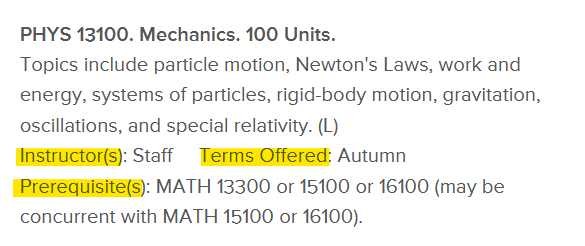
The Catalog gives you the course number and name, the course description, the scheduled professor, and any course prerequisites. The Catalog doesn't give you details such as days and times like the schedule does, but it projects courses through Spring quarter. That means you can use the Catalog to start tentatively planning for upcoming quarters now and the class schedule to narrow down and further solidify your course preferences when it is released.
Navigating the Class Schedule in My Classes
The next step in the registration process is picking out specific sections of the short-list of courses you discussed with your Academic Adviser, but before you can do that effectively, you need to understand what you're looking at.
Below we give you some insight on how to best use the Class Schedule, located in the My Classes portal in My.UChicago. Watch the video below for guidance on navigating My Classes.
Preparing for Pre-Registration
By now, through meeting with your Academic Adviser and reviewing the many sources of information, you've narrowed down your Autumn course options and thought and thought about how many courses you'd like to take in Autumn. So, what next?
As you start to search through the Class Schedule in My Classes, you'll notice many courses you're looking at have more than one class offering (or "section") during the Autumn quarter. The pre-registration system won't let you just say, "I want to be registered for HUMA 12300 Human Being and Citizen I, but I don't care which section." You will need to pick out specific sections and rank them in order of preference.
As you get started on that, we recommend that you think about your big-picture priorities and be prepared to be adaptable. You should think of pre-registration as a lottery, not a guarantee. The more flexible you are, the more likely it is that you'll end up with a schedule you're happy with. Also be aware that some classes that currently are listed as closed or consent only may have spaces made available for first years during pre-registration and can be requested.
Here are some tips:
- Request alternative and back-up courses. Let's take Hum as an example of why this is important. It’s perfectly fine if Media Aesthetics is your first choice Hum sequence, but requesting only Media Aesthetics sections doesn't guarantee you'd be able to get into one, and then you have no say in which Humanities you get instead. You should request sections of your second and third choice Hum sequences because it increases the odds that you end up in something you asked for. You should apply this mindset to all your course requests.
- Request alternative sections. Requesting only one section of a class can also create problems (for some large courses with only one section, this is fine, but if there are lots of sections to pick from - like MATH 15100 Calculus I - you need back-ups). You will have the ability to rank your preferred sections within each category, and the top-ranked sections will be given priority, so there's no reason not to pick out several section options when you're looking at the schedule.
- Remember your priorities and be adaptable. If your goal is to be an Economics major and you have a placement of MATH 13100, for example, it's absolutely essential that you take Calculus now. It may be that the section that fits best in your schedule is at 8:30am. Even if you’re not a morning person, you may need to be flexible if you want to pursue the major of your choice. And remember, you are only selecting courses for Autumn Quarter. In some – but not all – cases, you’ll have the chance to change things around in Winter and beyond.
- Request courses at a variety of times. The pre-registration system won't enroll you in two courses scheduled for the same time, so if your preferred sections in every category (Hum, Math, PHSC) are all at 11:00 on Tuesdays and Thursdays, you already know that you won't get some of your top choices. If you’re a morning person, keep an eye out for 8:00 or 9:00 am sections. Those tend to draw fewer requests and may be easier to get into. The same is true of courses in the late afternoon or early evening and labs after 5:00 pm.
- Don't forget about placements. The system may not restrict you from requesting a Math, Physics, language, etc. course based on your placement, but it will block the actual enrollment for courses that do not match your placement results. Even if you're hoping to change a placement once you arrive on campus, go ahead and request your current course placement in the meantime. If you're successful in changing your placement during Orientation Week, your College Adviser can help you adjust your schedule.
This part is really important, so we'll repeat it one more time: It's absolutely critical that you submit backup options as part of your course requests. You may not need as many options as you’ll include, but you'd much rather have them unnecessarily than get stuck with a schedule that can't be resolved based on information you submitted.
All students will submit their preferences for autumn quarter through the pre-registration system from August 17-21.
The pre-registration system allows you to rank subjects in order of their importance to you. When the system resolves everyone into their courses, that rank is taken into consideration.
Let's say you're a prospective Psychology major interested in completing pre-health requirements. Using the sample First Quarter Schedules, you've determined that in Autumn you will take: Humanities, Mathematical Sciences (Calculus, dependent on placement), and Physical Sciences (General Chemistry I, dependent on placement). Possible fourth course options are a language course (depending on outcome of placement test) or Art course.
So, Humanities, Calculus and General Chemistry should be top priorities for pre-registration rankings. But maybe you feel really strongly about when you have your Chemistry lecture and are more flexible about which Calculus course you take. In that case, you'd want to mark the Physical Sciences category as your number two priority, behind Humanities in number one, instead of Math or an elective. You'll also be able to rank preferences for individual class offerings within each category.
Visit my.uchicago.edu between 9AM on Monday, August 17 and 5PM CDT on Friday, August 21 to indicate your preference. During the pre-registration window in August, you’ll take the list of sections that you've put together and submit them on my.uchicago.edu. You will see a link on the right side of the my.uchicago.edu page entitled, First-Year Pre-Registration. This link will take you to a page where you will select and rank your top courses of interest. Note that picking and ranking your selections is NOT first-come, first-serve. As long as you get your selections in by 5PM CDT on August 221, your selections will be reviewed.
Pre-registration will break your choices down by category. You will see the following categories:
- Humanities
- Arts
- Civilization Studies
- Biological Sciences
- Physical Sciences
- Mathematics
- Language
- Other (elective courses such as computer science, economics, history, etc.)
You will then consider if you are interested in all of these categories. If you are not interested in taking a physical science course in your first quarter, then you will disregard this category and you will not pre-register for any physical science courses. You will only rank categories for courses that you would be open to taking in your first quarter. Your schedule will then be put together from the information you provide during the pre-registration week.
Please see screenshots below for more details on how the Pre-Registration process works. Click here for written step-by-step instructions on navigating the incoming student pre-registration process.
For now, focus on getting started on the prep work when the rest of the resources and placement tests start becoming available, and then review your selections with your Academic Adviser so all you need to do during your pre-registration window in August is submit your requests.
Pre-registration is an online process that requires internet access. If you will not have internet access during the pre-registration period, let your academic adviser know so they can be aware of your courses of interest.
What Happens Next
After the pre-registration window closes, the registration system will sort students into specific class sections. To do this, it will factor in how you prioritized each category and each class section within each category. So while there's no way to guarantee that you get the courses you've asked for, it is important to be thoughtful about how you rank the courses you request.
Your schedule will be available in your portal on or around September 8.
It is not always possible to get into the specific course sections you'd prefer. Perhaps there were more requests than seats and the section is now full, or maybe the section you requested conflicts with some other course in your schedule. Likewise, you won't be enrolled in any course for which you do not have the appropriate prerequisite or placement.
This is why it's important to provide back up options and pay attention to placements. Otherwise, you may find that you're enrolled in a different section of the course you requested. Remember: if you need to take CHEM 11100, for example, it's ultimately most important that you're able to take the course, even if that means your lab ends up being in the afternoon rather than the evening, as you might prefer.
Our goal is for you to have a complete schedule before you arrive for O-Week so that you can focus your energy on settling in and getting acquainted with campus. The more thorough you are in the course request process, the more likely you'll end up with a schedule that works for you. On occasion, conversations with the relevant department during O-Week will result in adjustments to your original placement, and that typically requires a schedule change to swap out the course based on the old placement in favor of a class reflecting the new one. Your College Adviser will help you navigate this when you meet with them during O-Week.
If you start in four courses and decide after a week or so that it'd be better for you to take three, that's fine. You have until Friday of 3rd week to drop a class without it appearing on your transcript. If you're considering this, be in communication with your College Adviser to ensure that you don't unintentionally drop something that will cause problems for you later on.
Not really! As you prepare for O-Week, you may want to find your textbooks. You'll have a variety of required and optional information sessions during Orientation Week to help you get acclimated to the UChicago campus. Some of those will be advising meetings - we look forward to meeting you in person then! If you have an epiphany after submitting courses and realize that you probably want to complete pre-health requirements after all, reach out to College Advising before then to discuss next steps.

